


It can be challenging to identify what is driving Donald Trump a month into the US and Israel's campaign of military action on Iran.
But it is apparent he has an eye on the oil markets.
A comment – or social media post – from the US president about his strategies once would ignite significant swings in prices, as investors seized upon signs the tensions could intensify or come to an end.
But in recent days, investors seem to be growing more doubtful about the significance of his remarks.
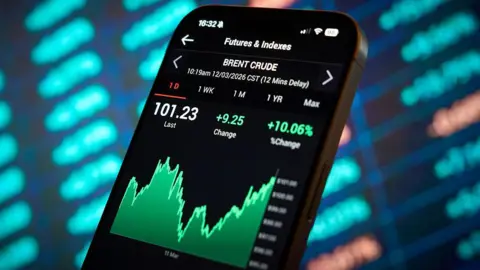
Crude oil was hovering around around $72 a barrel (bbl) before 28 February, when the military action against Iran commenced.
Recently, it climbed to $118 a barrel on 19 March and as of Friday afternoon was sitting at around $112 – substantially higher than its pre-war price.
Here are key instances from the recent weeks where Trump and the financial markets seem to have reacted to one another – with mixed impacts.
Navigate with the navigation button to move to the next slide.
"Energy prices have become a proxy for broader political and financial risks, surging when Trump's rhetoric becomes aggressive and declining when his rhetoric de-escalates," notes one financial expert.
He adds that markets are understandably sensitive to those signals, due to the substantial economic risks that come with rising oil prices.
"Market participants are trying to evaluate genuine uncertainty," he explains. "The markets can seem jumpy or confused, but what they're really doing is handling event risk in real time, with oil acting as the heart of that."
However, it can be challenging for investors to figure out how to trade, particularly because some of Trump's comments seem intended to affecting oil prices, instead of articulating policy, argues another market commentator.
"As the saying goes, the initial victim of conflict is truth," he observes. "My belief is much of the dialogue back-and-forth around productive talks, and the opposite, very much are aimed at just shifting the price of oil."
Investor Response Grow More Subdued
On a recent Thursday, minutes after US stock markets recorded their biggest drop since the start of the Iran war, Trump said talks with Iran were going "quite positively" and he was putting off military strikes on Iran's energy infrastructure until at least 6 April.
Yet, the price of crude continued to rise.
One head of FX strategy explains that investor responses are "becoming more muted" because of the "significant disconnect" between Trump's optimistic statements and the absence of confirmation from Tehran.
"Given the optics, many investors do not foresee an quick conclusion to the conflict and financial markets continue to be anxious."
Another investment director says markets have also adapted to Trump "frequently altering course at signs of political, stock market or economic trouble".
"We are seeing a amount of wariness, or even downright cynicism, taking hold at the edges," he concludes.


